Project overview
Sliced Bread Design was approached by a sustainability organization and an eDNA lab based out of UC Santa Cruz to figure out how we can lower the barriers to eDNA adoption.
Environmental DNA (eDNA) is a powerful methodology that catalogues organisms in an area by sequencing DNA from soil or water samples, but its complexity creates barriers to adoption. Our goal was to make eDNA accessible to scientists, researchers, and land managers.
Skills
User research, synthesis, UX design, user testing
Duration
March 2022 - July 2023
Research and synthesis
Figuring out where the challenges lie
Through user interviews, we identified a key disconnect: land managers need clear, actionable data to make decisions, while scientists and researchers are working with a lot of uncertainty around eDNA and loads of raw data they have to interpret.
I helped map out the whole process and we found challenges at nearly every step. We narrowed our focus to four key problems:
Getting started: Understanding how eDNA projects work
Sequencing: Accessing labs and geneticists
Analysis: Creating organism lists and analyzing across datasets
Sharing: Presenting and sharing large datasets
An overview of the eDNA process with challenges in each step
The silver lining - a collaborative community
Despite these challenges, we discovered everyone in this field loves collaborating through working groups, conferences, and personal networks. This presented an opportunity where we believed eDNA adoption could grow exponentially with the right network approach.
It wasn’t just the person-to-person network that we were excited about. We identified there were actually three interconnected networks - the life in the world, the people in the field, and the different methodologies. Our goal was to create a tool that could connect these networks to figure out what eDNA can be used for and how it complements other methods to help conservation efforts.
The three interconnected networks
Crafting the solution
Designing the tool
Working with our client, we envisioned a platform called eDNA Explorer where scientists, researchers, and managers could share their work, explore other eDNA projects, and get their own data analyzed. I explored multiple design directions through sketches for key pages, including project data and submission, species and project exploration, and community features.
Different ideas of how to display the Home page
Explorations for the project page
Variations for searching and exploring by keywords
Testing with users
I iterated on designs based on feedback from 9 participants (8 scientists/researchers, 1 land manager), validating key design decisions:
All participants loved the data visualizations with filtering by interests (species, invasives) and valued the networking aspect for collaboration
All 8 scientists and researchers loved seeing the project methodologies to understand how others structured their eDNA projects
5 of the participants who tested the project upload feature found it intuitive with straightforward data templates
8 out of 9 participants enjoyed the open-ended exploration through the search bar and map
An earlier version of the home page
An early draft to uploading a project
An early version of the organism list
refining and future explorations
Refining the upload experience
Once the beta site launched, we began to refine some of the details of the experience with feedback from invited users. One experience in particular was project submission - the main steps were nailed down, but there were a few usability improvements to make.
Using RITE (Rapid Iterative Testing and Evaluation) testing, I conducted sessions with 5 users to have them go through the whole process with their own data. The findings were reported back to the team so the engineers could implement quick changes, such as:
Auto-save indicators (“Saved 1 min ago”) for user confidence and peace of mind
Contextual help links addressing common questions about data privacy, upload process, and sequence data requirements
Pop-up clarifications for project privacy settings, data processing time, and adding more data or editing project information after submission
Project submission page before uploading any data
Data uploaded
Message to clarify what happens after submission
Ongoing contributions
After the initial launch, I contributed designs for new features the eDNA Explorer team was considering for future implementation.
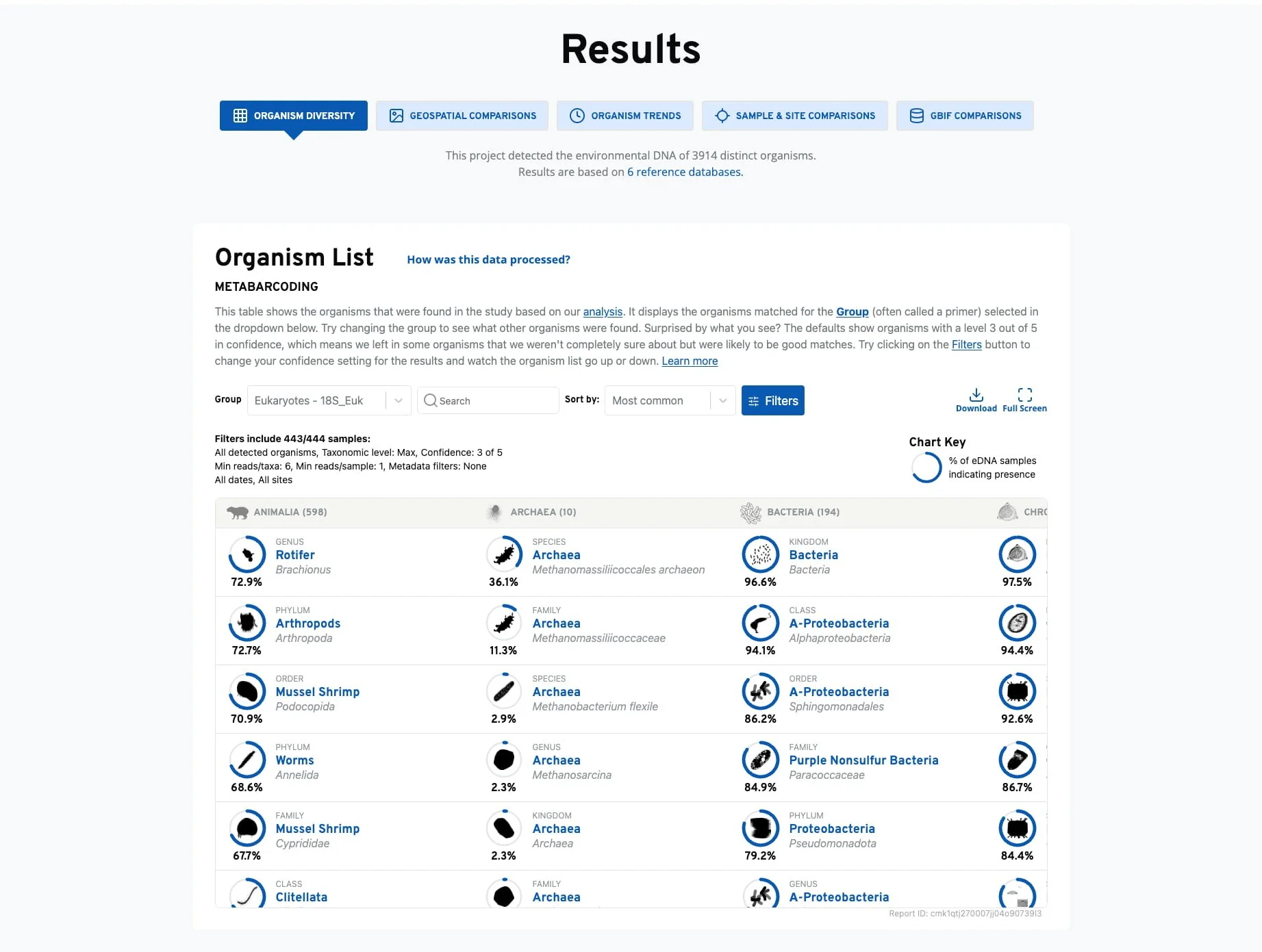
This included improving on the already popular organism list by including an overlay to highlight harmful, rare, and indicator species accompanied by ecosystem health insights.
An initial exploration at an overlay to show indicator, rare, and harmful organisms in the organism list
An iteration to also include a confidence score on the organism’s presence
The impact
Growing the network
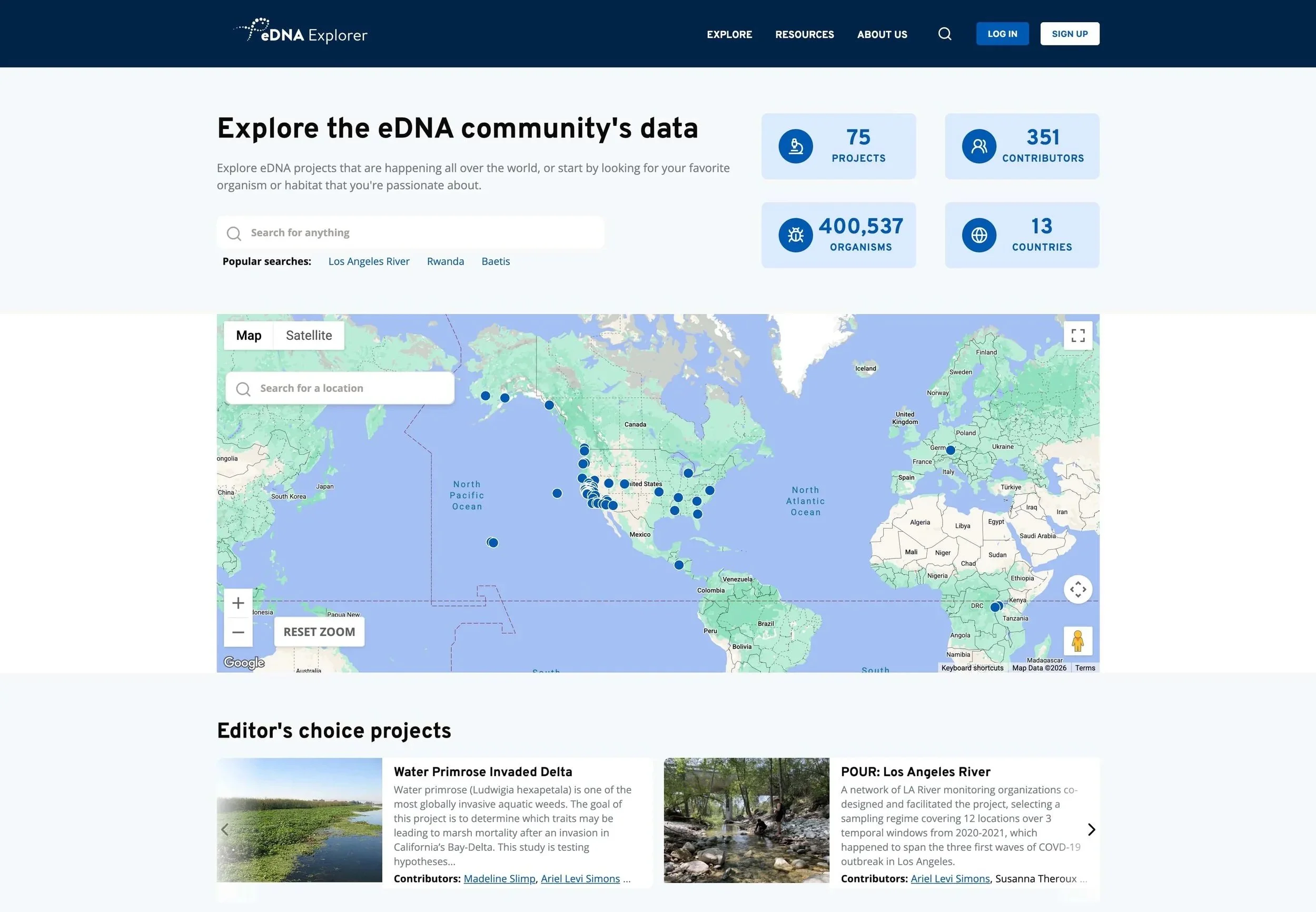
eDNA Explorer launched in November 2023 as a start-up. The platform now has over 350 contributors across 70 projects from 14 countries.
The startup has been helping companies launch their own eDNA project and recently received a grant to expand in Canada, continuing to grow the site and develop more functionalities to support conservation efforts.
In May 2024, I co-presented eDNA Explorer at the Digital Data in Biodiversity conference. I presented the research and design approach, while Julie Stanford (principal of Sliced Bread and CEO of eDNA Explorer) presented the site walkthrough and data analysis specifics.
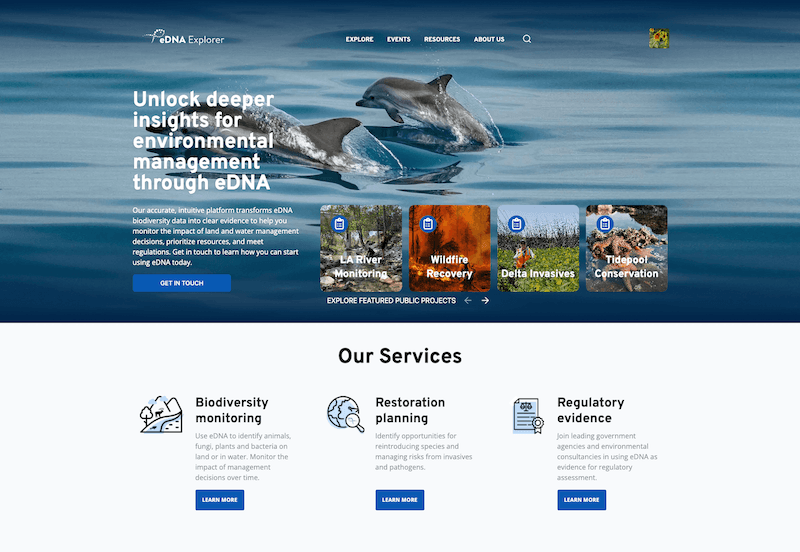
eDNA Explorer Home page