

Project overview
Sliced Bread Design was approached by Gap to understand how women shop for sports bra - specifically their experiences, pain points, and unmet needs - in order to inform an innovative shopping experience.
The focus was on women with larger cup sizes, as prior research suggested they faced the greatest difficulty finding supportive options
Skills
User research, synthesis, workshop ideation
Duration
October 2018 - November 2018
Needfinding prep
Creating research materials
I helped draft and finalize screener questions and an interview discussion guide. The interviews were structured to start with background on shopping habits and what women look for in a sports bra, then move into online browsing sessions to observe how participants navigated existing shopping experiences.
The second half of each session would involve a shop-along at several stores, including Gap-owned brands and competitors, to observe how women found, evaluated, and tested out the sports bras in person.
Interview session breakdown
First-hand shopping
Before the sessions, I went to a Title Nine store on my own to experience their approach firsthand. The bras were organized by each unique bra, placed in order of size on the rack, with no additional labeling.
I expected to browse independently, but a saleswoman approached me, asked what I was looking for, and when I said I was just browsing, picked out a few options and sent me to the dressing room. From there, she checked in after each try-on and grabbed different sizes based on my feedback. In the end, I left with a bra in a size I wouldn’t have picked myself, and with a realization: without that guided experience, I likely would have left empty-handed.
The trending insights
The bra choice depends on the scene
One of the most common patterns across participants was that the decision of which sports bra to wear wasn’t just about support - it was about context. Women are constantly weighing location, purpose, and plans against each other to figure out the right tradeoff between comfort, support, and appearance.
Location mattered a lot: whether they’d be seen in public, at yoga, at work, or just at home.
Purpose was also important: a less supportive, cute bra is acceptable for yoga, but not for running; at home, any old bra is fine.
Plans created another layer: finding a versatile bra to carry them from morning meetings to exercising after work without needing to change.
The different contexts women consider when choosing a sports bra
A long list of criteria - and potential dealbreakers
Women consider a large number of factors when shopping, and any one of them can make or break a purchase. They fell into rough tiers of dealbreakers, important-to-look-for, and nice-to-haves. It also depended on what each woman believed provided the support, which differed - some thought it was the band, others the straps, fabric, or cups - so there was no shared mental model to design against.
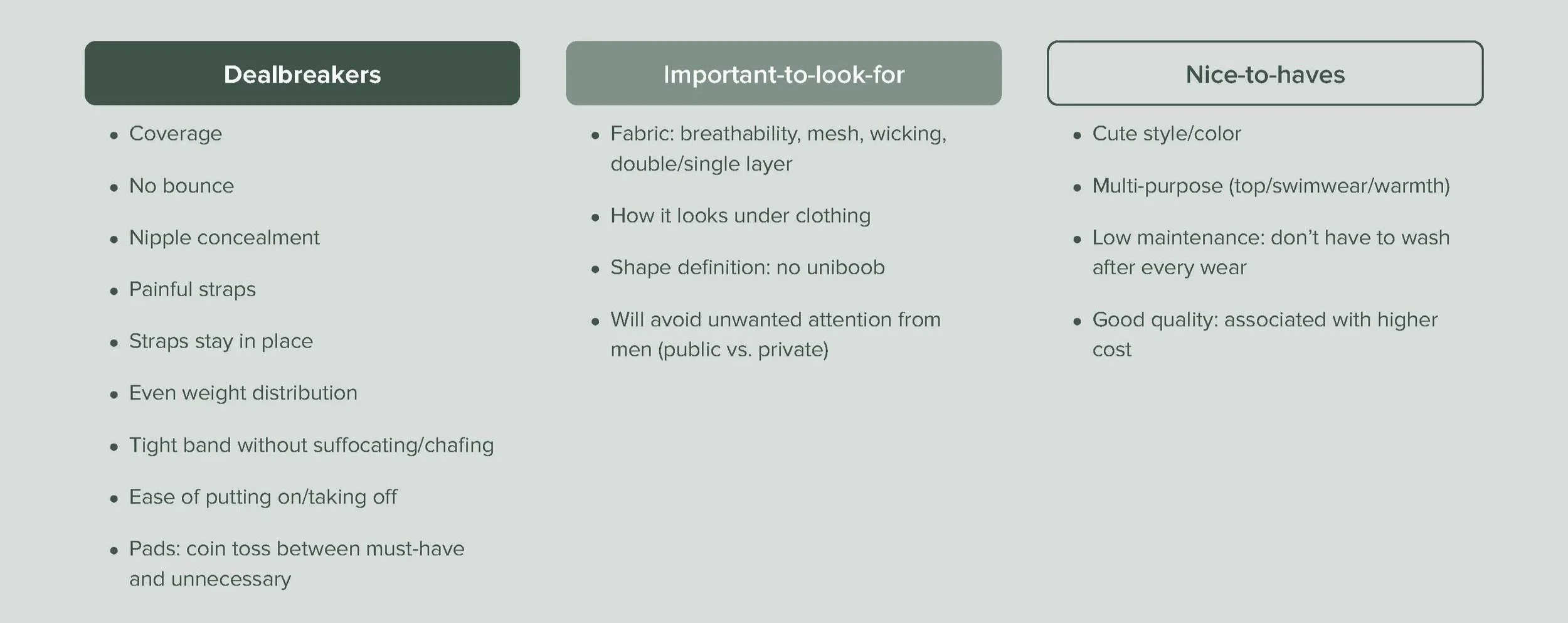
Long list of criteria women look for in sports bras
Confusing terminology and inconsistent sizing
A lot of brand- or store-specific terminology such as high/medium/low impact used to describe bras were misunderstood and meaningless. Many women used their own terms to describe support, such as “hold the girls in,” “no bounce,” “strapped in”. Marketing language like “Hyper Focused,” “Buttery Soft,” and “Run Free” were dismissed entirely as they offered no insight into how supportive the bra would actually be.
Sizing also added another layer of confusion: some stores used cup sizes, some S/M/L, some in dress sizes. No matter the sizing units used, women with larger cup sizes were most affected since they didn’t know what would truly fit them and their options were narrower.
The shopping experience
Online shopping
Shopping for bras online usually offered better selection and pricing, but the tradeoff is that women can’t assess material, fit, and support. Filters aren’t helpful either due to confusing terminology and unknown sizing patterns, and applying the filters could end up being too restrictive. Women also wanted reviews from people their own size and body type, clear return policies, and reliable sizing information.
Online bra quiz
We also reviewed findings from a prior online bra fit quiz study. The key takeaways:
Videos and illustrations were very helpful and the facts helped women understand what was wrong with their current bras.
Women who already had a sense of their sizing were more likely to second-guess the recommendations.
The questions felt similar to those from a fitting, which made the recommendations feel more trustworthy.
Women wanted to see models with their body shape.
They also wanted to answer questions around criteria preferences (straps, band, fabric), style, recent weight changes, and activity type.
They wanted instructions on how to measure yourself for a more accurate size.
In-store shopping
The shop-alongs to Gap-owned stores and the competitors (chosen based on where the women shopped frequently) also revealed that shopping in-person made it genuinely hard to find a good bra. The key takeaways:
Sports bras are scattered throughout the store, with confusing organization by marketing terminology (high/med/low), and a limited selection for size C+ women.
Women performed a range of physical tests both inside and outside the fitting room to determine support.
Many wanted a dedicated bra wall alongside with outfit inspiration.
Another consistent observation was the gap between what women said they preferred and what they responded to in the moment - someone who said she only bought black bras was drawn to a pink one because it was her favorite color; another who said she preferred a unisex look picked one she liked because it looked feminine.
Taking what we learned
Testing rapid experiments
After presenting our findings to the client in a workshop that included individual and group ideation, teams formed around different opportunity areas to build and test rapid experiments with participants. I supported one group in drafting the concept, facilitating, and taking notes. The experiment focused on helping participants find the right fit through a more personalized, guided approach, which resonated strongly with the women.
The impact
Supporting the shopping experience
The research gave Gap a set of focused findings to guide their next steps. Some findings reinforced what prior research had suggested - support, comfort, and fit remain the top priority; bad fit, awkward pads, and the tension between functionality and comfort are the biggest pain points. But several new findings opened up some new directions:
The public/private framework hadn’t been surfaced before and explained why women feel differently about the same bra in different contexts.
The full list of criteria revealed how many factors are in play simultaneously, and how personal the tradeoffs are.
The failure of the high/med/low system pointed to an opportunity to communicate about sports bras in language women already use.
Both online and in-store experiences had meaningful gaps and the research surfaced actionable directions for each.
These findings gave Gap a foundation towards a shopping experience that reflects how women actually make decisions.